Roland Bullard
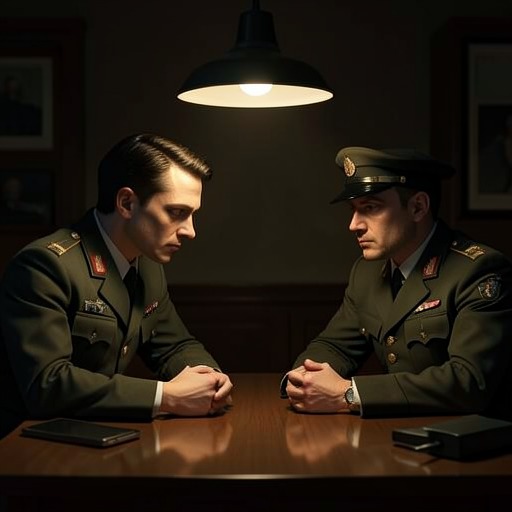
The Zone of InterestRoland Bullard is a British captain held in the camp and a clandestine saboteur whose defiance briefly gives Angelus Thomsen a way to act against the regime from within. The damaged machinery Bullard leaves behind becomes both evidence of resistance and the opening to a perilous connection: Thomsen seeks him out, offers coded signs of recognition, and asks whether others are involved.
Identity and Introduction
Bullard first comes into view through the traces of his work rather than a full account of his past. On the last day of November, Thomsen follows him into a tool cabin between the Stalags, where Bullard has laid out the components of a dismantled welding gun on a pillowslip. The improvised concealment makes the cabin a point of contact between the camp’s ordinary industrial routines and an underground effort to interfere with them.
Thomsen has also been watching Bullard at work. He tells him that the previous day he saw him bending the blades of a cooling fan in the Polimerisations-Buro, and says that he liked what he saw. Bullard’s surprise at this approval marks the encounter as a test: Thomsen is not merely identifying sabotage, but trying to determine whether the man responsible can be trusted.
To make his approach, Thomsen offers cigarettes and invokes British patriotism through a passage from “Rule Britannia.” Bullard studies him before responding, while Thomsen makes clear that he is tired of the regime and asks whether Bullard can provide information. Their exchange establishes a cautious partnership rather than a simple act of recruitment: Bullard is valued for what he knows and can do, but both men must first decide whether the other understands the danger of speaking openly.
Resistance, Capture, and Death
The approach to Bullard opens a narrow channel between Thomsen and the British prisoners involved in sabotage. Thomsen offers himself as a source of information, and Bullard’s willingness to continue the exchange turns his acts of damage into something more consequential than isolated interference. Their alliance rests on careful recognition: Thomsen has watched Bullard at work, while Bullard must judge whether a German officer’s apparent break with the regime is genuine. The conversation’s guardedness reflects the danger of converting covert resistance into contact.
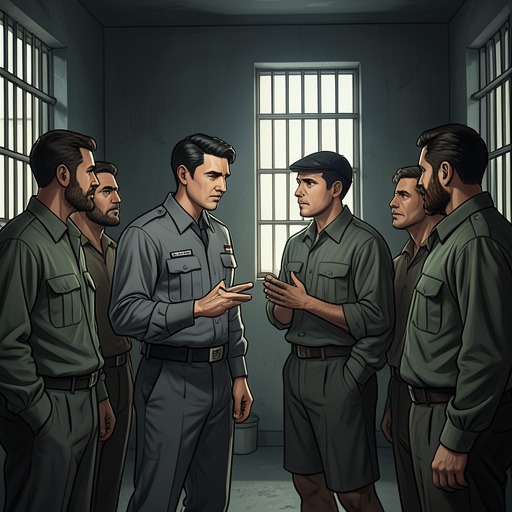
Bullard’s later fate shows how quickly that channel could be crushed. During an interrogation, he is found lying on the dirt with Michael Off, who has been kept in a crouch-box for seventy-two hours. Fritz Mobius notes that Professor Entress has already subjected Bullard to the probe twice; the account reports that Bullard seems to welcome the ordeal. The spectacle is rendered through the damage to his body: his head resembles a halved pomegranate, and Mobius nudges him with a boot. Mobius then orders an agent to fetch a woman from Kalifornia, observes that Bullard’s eyes are gone, and fires into the straw mattress. Bullard twitches; Mobius treats his blindness not as a reason to stop but as proof that he can still listen. The scene reduces a resistant officer to a body subjected to torture, while the interrogators persist in treating him as an instrument from which something can still be extracted.
The narrative later gives Bullard’s death a blunt chronological place among several losses. He receives a bullet in the back of the neck on May Day, after Szmul’s death and before Mobius’s fatal heart attack. His killing closes the brief prospect of cooperation with Thomsen: the sabotage that had made Bullard visible also left him exposed to the camp’s machinery of interrogation and execution.
The Limits of the Alliance
The approach is framed through small, recognizable signals rather than an announced plan. Thomsen brings Woodbine cigarettes, which Bullard welcomes, and tests their understanding through a reference to British national identity. He also states that he is finished with the Third Reich’s promise of a thousand-year reign; Bullard answers by extending its imagined endpoint to 2933. Their dry exchange turns the regime’s grand claim into a private joke, but it does not erase the danger of their contact.
Thomsen offers to provide information and asks whether Bullard knows of others. The exchange establishes the possibility of a wider circle, not its membership, reach, or specific objectives. Bullard’s importance therefore rests on a narrow but consequential threshold: his sabotage has made him visible to Thomsen, and their cautious conversation opens a channel between a British prisoner and a German officer disillusioned with the regime. The narrative offers no comparable account of Bullard’s history or private thoughts; his character emerges through what he risks doing and through the judgments others make of him.
Resistance Against the Camp’s Moral Language
Bullard’s sabotage stands in sharp opposition to the language by which the camp’s authorities defend their actions. Paul Doll insists that kindness to Jews would mean cruelty to Germans and replaces ordinary distinctions between right and wrong with calculations of positive and negative outcomes. Bullard’s quiet damage to equipment offers no competing doctrine or speech; its significance lies in the practical refusal to cooperate with a system that presents violence as duty and efficiency as justification. The contrast makes his resistance more than an industrial nuisance: it exposes the distance between the regime’s claims of order and the coercion required to maintain them.
The narrative also places Bullard’s fate within a world where violence has been made routine enough to be treated as procedure. Paul Doll’s questions about the stench, drunkenness, disease, and death at the camp unsettle his own insistence on normality, while his language of obedience links the living to corpses. Bullard is not shown sharing in that self-interrogation; he appears through acts and through the violence inflicted on him. That asymmetry matters. The perpetrators’ words expose a system trying to explain itself, while Bullard’s resistance makes visible the human cost that their explanations cannot contain.